ArrowETC



Deprecation Notice
Note: This package has been deprecated and is no longer maintained as a standalone module.
The functionality of ArrowETC has been fully integrated into the LogicTreeETC package, which includes not only the ArrowETC arrow-drawing engine, but also logic box layout tools and image feature detection via OpenCV.
To continue receiving updates and support, please install the LogicTreeETC package:
pip install logictreeetc
And import ArrowETC as follows:
from logictree import ArrowETC
ArrowETC is a Python library for building flexible, multi-segmented arrows with explicit vertex control – perfect for precise, publication-quality diagrams. It was designed as a drop-in replacement for matplotlib’s FancyArrow and FancyArrowPatch, providing far greater control over arrow geometry, corners, and paths.
Motivation
While FancyArrow and FancyArrowPatch in matplotlib offer basic arrow-drawing capabilities, they suffer from limited control: they don’t expose explicit vertex data, they lack support for multi-segment paths, and they provide no access to corner calculations for sharp mitered joints or smooth curves.
ArrowETC was created to overcome these limitations by giving full access to the arrow’s properties, allowing:
Multi-segmented arrows with arbitrary bends.
Accurate miter or curved joints.
Optional smooth Bezier curves through control points.
Easy addition of custom arrowheads with precise placement.
Metadata about segment lengths and angles for advanced use.
This was essential for building LogicTreeETC, a Python framework for generating logic and decision trees with annotated boxes connected by precise arrows representing information flow.
Features
Straight or curved arrows: Draw arrows as straight lines or smooth Bezier curves through path points.
Multi-bend support: Create arrows with multiple corners and arbitrary joint angles.
Precise arrowheads: Add flared arrowheads with geometry matched to the arrow shaft.
Explicit geometry access: Retrieve each polygon vertex for alignment, collision detection, or annotation.
Matplotlib-ready: Output vertices directly usable in your matplotlib plots.
Installation
ArrowETC requires Python 3.10+ and the packages numpy, matplotlib, and scipy. Install via pip:
pip install arrowetc
Dependencies
ArrowETC requires the following Python packages:
numpymatplotlibscipy
Examples
Below are practical examples showcasing what ArrowETC can do. These scripts generate images demonstrating straight, multi-segmented, and curved arrows with various configurations:
Matplotlib integration
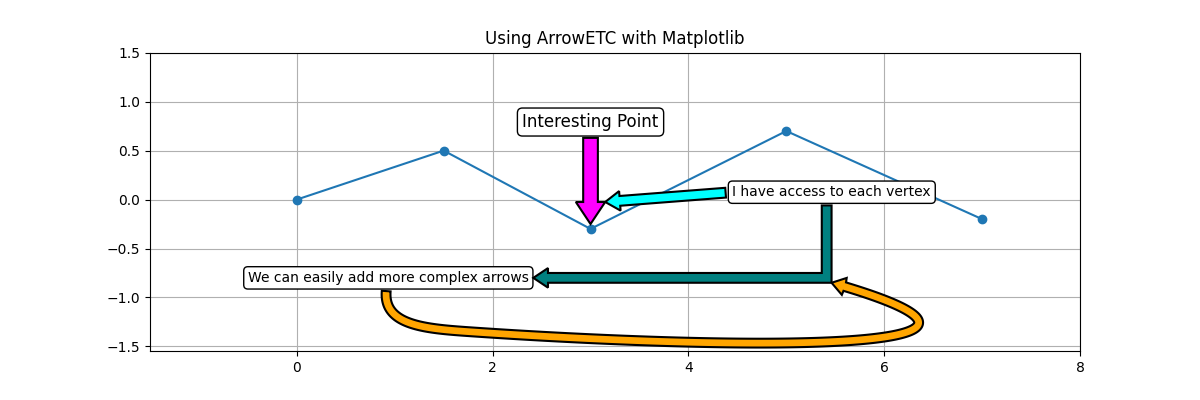
See https://github.com/carret1268/ArrowETC/blob/main/examples/example_with_matplotlib.py for a complete example demonstrating how to use ArrowETC as a drop-in replacement for matplotlib arrows. The example shows how to add ArrowETC arrows pointing from annotation boxes to points on a scatter plot, or other annotation boxes, or even specific vertices on another arrow; including straight, segmented, and curved Bezier arrows – perfect for creating polished, publication-quality figures with precise control over arrow geometry.
Basic arrow with head
Draws a straight vertical arrow with an arrowhead at the tip. This demonstrates the simplest use of ArrowETC as a direct replacement for matplotlib’s FancyArrow.
path = [(0, 0), (0, 4)]
arrow = ArrowETC(
    path,
    arrow_width=0.5,
    arrow_head=True,
    ec="white",
    fc="cyan"
)
arrow.save_arrow(base_path / "basic_arrow_with_head.png")

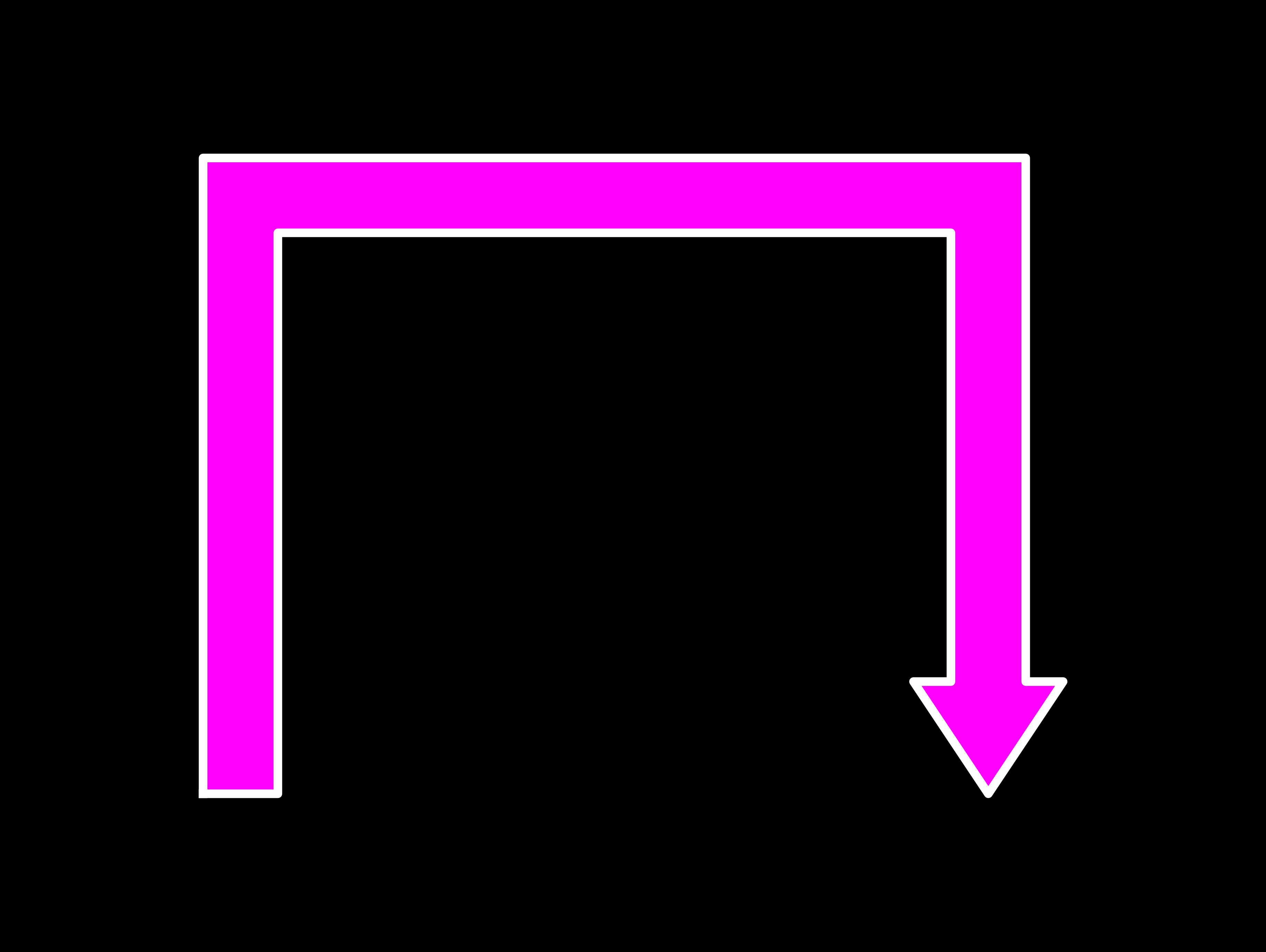
Multi-segment arrow with head
Draws an arrow that bends twice – showcasing ArrowETC’s support for arbitrarily segmented arrows with mitered joints.
path = [(0, 0), (0, 4), (5, 4), (5, 0)]
arrow = ArrowETC(
    path,
    arrow_width=0.5,
    arrow_head=True,
    ec="white",
    fc="magenta",
    lw=2
)
arrow.save_arrow(base_path / "multi_segment_arrow_with_head.png")
Obtuse angle arrow
Illustrates how ArrowETC handles obtuse bends smoothly with obtuse corners.
path = [(0, 0), (4, 0), (8, 2)]
arrow = ArrowETC(
    path,
    arrow_width=0.5,
    arrow_head=True,
    ec="white",
    fc="orange"
)
arrow.save_arrow(base_path / "obtuse_arrow_with_head.png")

Acute angle arrow
Shows an arrow with an acute angle, where the shaft sharply turns – highlighting ArrowETC’s ability to produce clean miters even for tight angles.
path = [(0, 0), (4, 0), (1, 4)]
arrow = ArrowETC(
    path,
    arrow_width=0.5,
    arrow_head=True,
    ec="white",
    fc="cyan"
)
arrow.save_arrow(base_path / "acute_arrow_with_head.png")

More complex multi-segmented arrow
Shows how the ArrowETC object can handle more complicated paths.
path = [(0, 0), (1, 2), (2, -1), (4, -2), (5, 0), (7, 0)]
arrow = ArrowETC(
    path,
    arrow_head=True,
    arrow_width=0.2,
    ec="white",
    fc="cyan"
)
arrow.save_arrow(base_path / "many_segments_with_head.png")

Multi-segmented arrow without arrowhead
Creates a segmented rectangular “pipe” without an arrowhead, useful for process diagrams or connectors where a directional tip is unnecessary.
path = [(0, 0), (0, -10), (10, -10), (10, 0)]
arrow = ArrowETC(
    path,
    arrow_width=1,
    arrow_head=False,
    ec="white",
    fc="cyan"
)
arrow.save_arrow(base_path / "multi_segment_no_head.png")

Basic Bezier arrow with head
Uses a smooth Bezier curve instead of straight segments.
path = [(0, 0), (4, 0), (8, 2)]
arrow = ArrowETC(
    path,
    arrow_width=0.5,
    arrow_head=True,
    bezier=True,
    ec="white",
    fc="orange"
)
arrow.save_arrow(base_path / "basic_bezier_with_head.png")

Complex Bezier arrows
Low bezier_n:
bezier_n=400– demonstrates how too few sample points can distort the arrowhead or tip on sharp, complex curves.
path = [(0, 0), (4, -5), (8, 2), (16, -8)]
arrow = ArrowETC(
    path,
    arrow_width=1,
    arrow_head=True,
    bezier=True,
    ec="white",
    fc="cyan"
)
arrow.save_arrow(base_path / "crazier_bezier_with_head-low_n.png")
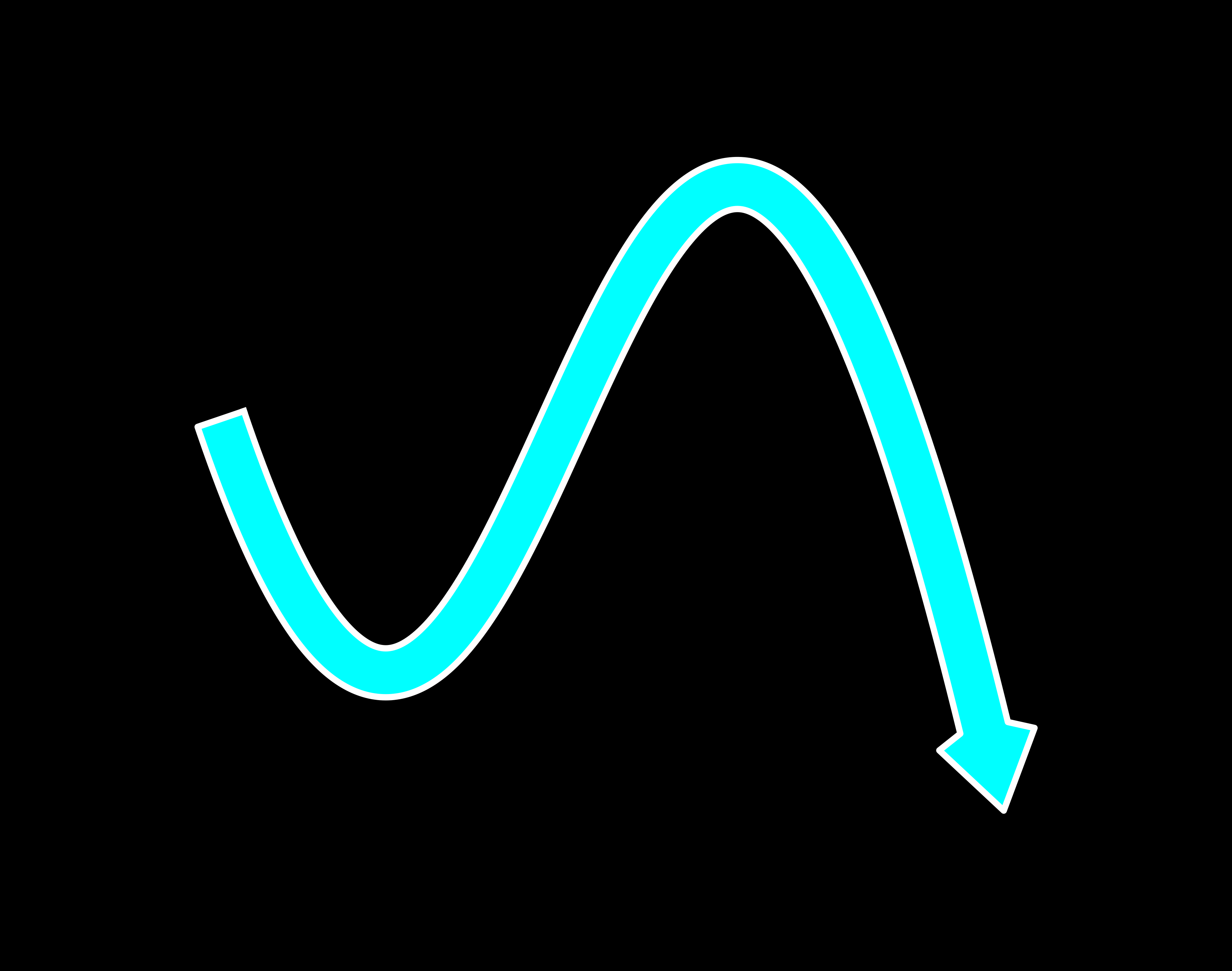
High bezier_n:
bezier_n=800– shows a smooth, high-resolution arrow even along aggressive curves, fixing tip skew.
path = [(0, 0), (4, -5), (8, 2), (14, -8)]
arrow = ArrowETC(
    path,
    arrow_width=1,
    arrow_head=True,
    bezier=True,
    bezier_n=800,
    ec="white",
    fc="cyan",
)
arrow.save_arrow(base_path / "crazier_bezier_with_head-high_n.png")
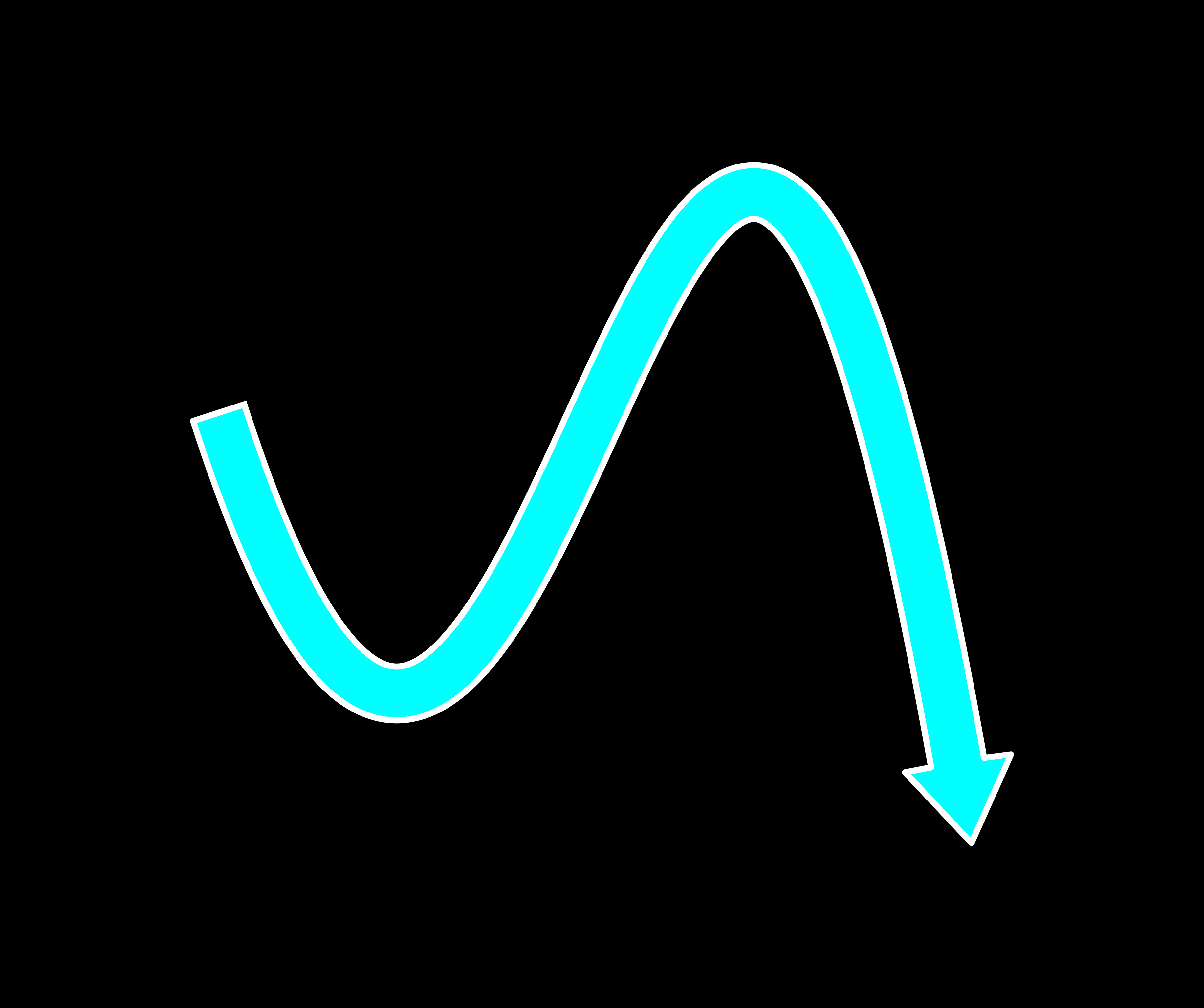
These examples illustrate how ArrowETC can handle everything from straight connectors to advanced, smooth curved paths – making it an ideal replacement for matplotlib’s limited arrow types, and a powerful tool for your custom diagrams.
For reference, all example scripts are included in the examples/ directory. The generated images are saved in the resources/ directory.
Development
This project uses the following tools for code quality and security:
Ruff: for fast linting and auto-formatting checks.
mypy: for static type checking.
Bandit: for security scanning.
GitHub Actions CI: runs tests, type checks, linting, and security checks on every push.
Dependabot: automatically checks for dependency updates.
See the .github/workflows/ directory for CI configurations.
License
This project is licensed under a CC0 License. See LICENSE file for details.
GitHub Link
Contents: